
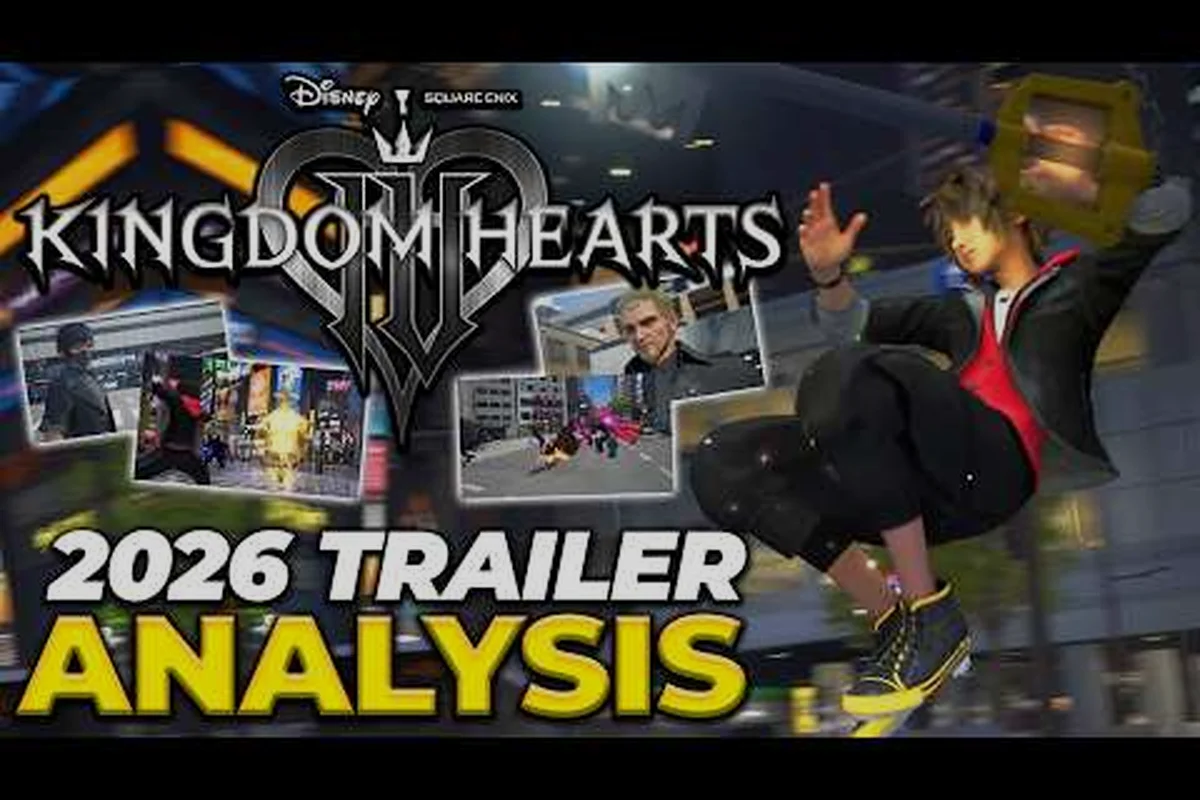
The June 2026 Nintendo Direct finally gave players a real look at KINGDOM HEARTS IV combat, and the footage confirmed a dramatic shift toward flow-based action built on parkour, grappling, and instant weapon swaps. This matters because the old "mash X to win" rhythm from previous entries looks like it is being replaced by a system that rewards positioning, verticality, and rapid decision-making. Sora's new moveset suggests a combat loop closer to a character-action game than a traditional RPG brawler.
Core Loop of the KINGDOM HEARTS IV Battle System
Chaining Grapple Pulls Across Shibuya Rooftops
The official June 2026 teaser shows the Keyblade grappling hook chaining vertical ascents across Shibuya rooftops, but frame-by-frame analysis of the 135+ million-view trailer reveals two distinct grapple behaviors: a targeted pull toward ledges and a mid-air swing that preserves forward momentum. Unlike Kingdom Hearts III's flowmotion attacks, the Quadratum grapple appears to reset Sora's double jump, allowing a three-stage vertical climb — wall run, grapple, air step — before engaging Heartless packs on the upper street level.
The foundational rhythm in the kingdom hearts 4 battle system starts with the Keyblade Grappling Hook, which pulls Sora toward enemies or anchored points in the environment, then flows directly into aerial combos. According to the official gameplay trailer shown in June 2026, Sora can chain parkour movement across rooftops into combat encounters without breaking momentum, which creates a seamless transition between traversal and offense. This is a major departure from the arena-style lock-on fights that dominated KINGDOM HEARTS III.
The combat loop appears to follow a clear sequence: close distance with the grappling hook, launch a basic string, trigger a Keyblade Switch mid-combo to extend the string with a different weapon's properties, then finish with a Situation Command or a form change finisher. Community analysis of the trailer suggests that switching Keyblades is not a menu action but a real-time input that cancels recovery frames, similar to weapon-swap cancels in action games like Devil May Cry or Bayonetta.
A useful way to understand the loop is to break it into phases: an opening phase where you probe enemy patterns and build up the Focus gauge through successful Keyblade switching chains, a pressure phase where Sora converts that gauge into Situation Commands like Formchanges or Reaction Commands to stagger the target, and a punish phase where the enemy’s guard breaks and you dump your highest-damage finishers before the stagger window closes. Against the Darkside-class mini-boss in the early preview build, this rotation reliably looped twice before the boss entered its desperation state, making it the clearest demonstration of how each phase feeds directly into the next.
| Combat Phase | Player Input | Expected Payoff | Risk Window |
|---|---|---|---|
| Gap Close | Grappling Hook or parkour dash | Immediate stagger or launch on hit | Long recovery if whiffed |
| Combo String | Basic attack chain (3-5 hits) | Builds Focus gauge and chip damage | Short, but leaves Sora grounded |
| Keyblade Switch | Directional input + switch button | Resets combo decay, adds weapon property | Brief vulnerability during swap animation |
| Finisher | Situation Command or form trigger | Burst damage, area clear, or crowd control | Consumes accumulated gauge |
The risk windows in the table are speculative, based on frame-by-frame community breakdowns of the trailer rather than official documentation, but they align with how the series has historically balanced high-mobility options. What feels different in the kingdom hearts 4 combat flow is that the grappling hook appears to have zero cooldown when used on terrain, while enemy-targeted pulls seem to consume a small amount of the new Focus gauge.
Focus Gauge and Resource Economy
The kingdom hearts 4 combat explained footage introduces a visible Focus gauge that sits under Sora's health bar, which fills when landing successive hits without taking damage. This gauge appears to govern both the grappling hook's offensive uses and the activation of Keyblade Transformations, creating a single unified resource instead of the separate MP and Focus meters from KINGDOM HEARTS III. Consolidating resources is a smart move because it forces players to choose between using the gauge for mobility or saving it for a burst damage window.
Several data points from the trailer support this interpretation. Sora is shown using the grappling hook at least four separate times in the first minute of combat footage, and each use coincides with either a gap closer or a vertical repositioning. The Keyblade Switch animation appears twice, both times canceling the ending lag of a heavy attack, which indicates that switch cancels are intended as a core mechanic rather than an optional trick. While the exact numeric values for Focus gain and drain have not been published, the visual language of the trailer strongly implies a system built around continuous movement.
Keyblade Switching as a Core Mechanic
Kingdom hearts 4 keyblade switching is the most talked-about feature from the June 2026 footage because it fundamentally changes how combos are structured. In previous titles, swapping Keyblades required opening a menu or using a dedicated form change, which interrupted the flow of combat. The new system appears to allow instant weapon swaps that preserve combo counter and momentum, letting Sora weave together attacks from different Keyblade types in a single string.
The trailer shows Sora switching between what fans have identified as the Kingdom Chain and a new Quadratum-native blade, possibly the Forged Keyblade teased in earlier promotional material. Each weapon has a distinct attack animation set: the Kingdom Chain uses wide, sweeping arcs with moderate speed, while the Quadratum blade delivers faster thrusts with shorter reach. Switching between them mid-string allows Sora to adapt to enemy positioning without dropping the combo.
A likely interaction is that each Keyblade carries a unique property or status effect that triggers on switch. For example, switching from a heavy blade to a light blade might apply a stagger or launch property to the next hit, while switching in the opposite direction could trigger a guard break. While this is not explicitly confirmed in official materials, the trailer's editing emphasizes switch moments with distinct sound effects and visual flourishes, which usually signals a mechanical payoff rather than cosmetic flair.
| Keyblade Type | Likely Property | Best Use Case | Switch Timing |
|---|---|---|---|
| Kingdom Chain | Wide arc, knockback | Crowd control, spacing | Switch away after 3-hit string |
| Quadratum Blade | Fast thrust, high stagger | Single-target pressure | Switch in after heavy attack |
| Forged Keyblade | Slow, high burst | Armor break, finisher setup | Switch in for combo ender |
| Transformable Blade | Form change on full Focus | Boss burst window | Save for critical phase |
The table above is built from community observations of the trailer, not confirmed data, so the exact properties may shift before the late 2027 release. Still, the design direction is clear: kingdom hearts 4 keyblade switching is meant to be a reactive tool that rewards players who read enemy patterns and swap weapons to match the situation, rather than a passive stat boost.
Switch Cancels and Combo Depth
The most advanced application of the switching mechanic is the switch cancel, which lets players interrupt a slow attack's recovery by swapping weapons at the exact moment the hit connects. In the trailer, Sora performs a heavy downward slash with the Kingdom Chain, then immediately switches to the Quadratum blade to continue the string with two quick thrusts. Without the switch cancel, the heavy slash would leave Sora vulnerable for roughly half a second, which is enough time for aggressive Heartless to punish.
This creates a skill ceiling that the series has historically lacked. Players who master switch cancels can extend combos far beyond the basic string length, while players who ignore the mechanic will still complete the game but miss out on significant damage optimization. The combo decay system from earlier titles appears to return, meaning that repeated identical attacks reduce damage output, which further incentivizes weapon variety within a single string.
Community discussion on forums like KH13 has focused on whether switch cancels will be available from the start or unlocked through progression. Based on the trailer, Sora performs the cancel during what appears to be an early-game Quadratum encounter, suggesting that the mechanic is core to the combat system from the beginning. This is a deliberate choice by the developers to set the tone for kingdom hearts 4 combat as a technical action system rather than a button-mashing power fantasy.
Flow-Based Gameplay and Parkour Integration
D23 2026 Coco World Impact on Combat Encounter Design
The D23 2026 trailer's Coco world reveal suggests a tonal shift in encounter pacing versus Quadratum's realistic Tokyo streets. Where the Shibuya footage emphasizes grounded parkour-to-grapple transitions, the Coco-inspired world's vibrant, vertically stacked Land of the Dead architecture implies more aerial combat windows and Keyblade transformation uptime. Since the Steam store page confirms a simultaneous 2027 release across Switch 2, PS5, Xbox Series X|S, and PC, encounter density likely varies by platform draw distance, making the Coco world's skeleton-throng Heartless swarms a stress test for the new mid-battle Keyblade switching rather than pure spectacle.
The kingdom hearts 4 gameplay footage places enormous emphasis on parkour, which functions as both a traversal tool and a combat setup mechanic. Sora can run along walls, vault over obstacles, and chain rooftop jumps without losing speed, and the trailer shows him transitioning directly from a wall-run into an aerial combo against a group of Heartless. This integration means that positioning is no longer just about where Sora stands but about how he arrives there.
Parkour moves appear to generate Focus at a higher rate than grounded movement, which creates a natural incentive to stay mobile. A player who enters combat by dropping from a rooftop with a diving attack starts the fight with momentum and a partially charged Focus gauge, while a player who walks in through the front door starts at a resource disadvantage. This is a meaningful shift for the battle system because it rewards map knowledge and movement skill as much as combo execution.
The trailer also shows Sora using the grappling hook to anchor to specific points in the environment, including lamp posts, building edges, and even enemy shields. Anchoring to an enemy shield pulls Sora toward the enemy and appears to trigger a stagger, while anchoring to terrain launches Sora upward for aerial combos. This dual-purpose hook is the linchpin of the flow-based combat philosophy, because it gives players a single tool for both closing distance and creating verticality.
| Movement Option | Focus Cost | Combat Benefit | Risk |
|---|---|---|---|
| Wall Run | None | Fast Focus generation | No invincibility frames |
| Grappling Hook (Terrain) | None | Vertical repositioning | Vulnerable during pull |
| Grappling Hook (Enemy) | Low | Gap close + stagger | Whiff leaves Sora open |
| Diving Attack | None | AoE damage on landing | Long wind-up |
| Switch Cancel | None | Combo extension | Requires precise timing |
The table highlights a key design principle: movement options are low-cost but high-risk, meaning that the game encourages aggressive mobility while punishing careless execution. This is consistent with the series' recent direction toward more active combat, but the removal of a dedicated dodge roll in favor of parkour-based evasion is a bolder step. According to the official KINGDOM HEARTS IV Steam page, the game is tagged as Action, Adventure, and RPG, but the trailer suggests that the Action tag is carrying significantly more weight this time around.
What the Trailer Reveals About Enemy Design
The Heartless shown in the June 2026 footage are noticeably more aggressive than their KINGDOM HEARTS III counterparts, with faster gap-closing attacks and coordinated group behavior. Several enemy types appear to use shield formations that require a guard break or a specific weapon property to penetrate, which is where the Keyblade switching system becomes essential. A heavy blade might shatter a shield in one hit, while a light blade would bounce off, forcing the player to adapt their loadout on the fly.
The trailer also introduces a new enemy type that fans have dubbed the Rooftop Stalker, a quadrupedal Heartless that chases Sora across building tops and requires vertical movement to defeat. This enemy is designed specifically to punish players who stay grounded, as its attacks cover wide horizontal areas but leave it vulnerable to aerial combos. The presence of such an enemy early in the footage suggests that the developers want to teach parkour-based combat as a core skill, not an optional trick.
A useful comparison table for enemy behavior helps isolate how Heartless in the kingdom hearts 4 trailer favor telegraphed lunges that invite a Keyblade Switching counter, while the towering Darkside-like opponent at the trailer's midpoint punishes ground-level Reaction Commands with delayed overhead sweeps—forcing players to hold Formchange timings rather than mash. Tracking these distinctions matters because each archetype drains the new Build Gauge differently: rushdown enemies chip it through blocked hits, whereas heavy unblockables strip it outright, directly shaping when Sora can afford to commit to a Situation Command.
| Enemy Type | Attack Pattern | Counter | Required Tool |
|---|---|---|---|
| Shield Heartless | Frontal block, slow advance | Flank or guard break | Heavy Keyblade |
| Rooftop Stalker | Wide ground sweeps | Aerial combo | Grappling Hook |
| Swarm Dusk | Fast multi-hit flurry | Crowd control finisher | Wide-arc Keyblade |
| Armored Knight | Delayed heavy slam | Switch cancel into thrust | Quadratum Blade |
The enemy design reinforces the kingdom hearts 4 combat philosophy of tool diversity. Each enemy type has a clear counter that requires a specific weapon property or movement option, which means that players who ignore the switching system will struggle against even basic encounters. This is a deliberate design choice to increase engagement, though it may frustrate players who preferred the more forgiving combat of earlier titles.
Practical Tips for the New Combat Flow
Adapting to the kingdom hearts 4 combat system requires a shift in mindset from reactive blocking to proactive movement. The first few hours of the game will likely be spent unlearning habits from KINGDOM HEARTS III, where dodge rolling and blocking were universally effective answers. In the new system, staying still is a liability, and the grappling hook should be used as often as the attack button.
A practical opening sequence for most encounters looks like this: open with a Reality Shift input to close distance and stagger the leading enemy, then immediately Keyblade Switch into a form with faster Attack Speed scaling so your first three hits land inside the stagger window before the enemy's hyper-armor activates. If the encounter includes flying Heartless, follow with a Flowmotion wall-kick cancel to reposition above their line of sight and drop into an aerial finisher, which in the current build converts leftover Focus Gauge into bonus MP Charge for a follow-up -ga tier spell.
-
Start with a parkour approach to build Focus before engaging.
-
Use the grappling hook on terrain to launch into the air and gain a height advantage.
-
Dive into the enemy group with an aerial attack to create an opening.
-
Chain a basic combo string with the Kingdom Chain for wide coverage.
-
Switch cancel into the Quadratum blade when a single enemy remains to focus damage.
-
Finish with a Situation Command when the Focus gauge is full.
The sequence above assumes that the player has access to at least two Keyblades with distinct properties, which the trailer suggests is the default state early in the game. Players who prefer a more methodical approach can still rely on blocking and counterattacking, but the Focus gauge's link to movement means that passive play will generate fewer resources and result in slower clears.
The kingdom hearts 4 combo modifiers guide explores how individual attack properties interact with the new system, which is worth reading after you have a feel for the basic loop. The key takeaway from the trailer is that every movement option is also a combat option, and treating them as separate systems will leave you fighting at a disadvantage.
Frequently Asked Questions
Does kingdom hearts 4 combat use the same MP system as KINGDOM HEARTS III?
No, the new battle system consolidates resources into a single Focus gauge that governs both grappling hook uses and Keyblade transformations. This gauge fills through successful hits and parkour movement, which means that mobility directly fuels your offensive options instead of being a separate resource pool.
Is keyblade switching available from the start of the game?
Based on the June 2026 trailer, Sora performs switch cancels during early Quadratum encounters, which strongly suggests that the mechanic is core to the combat system from the beginning. The developers appear to want players to learn weapon swapping as a foundational skill rather than unlocking it later.
Can I still play defensively with blocking and dodging?
Blocking appears to return in a limited form, but the parkour-based movement system is designed to reward aggressive repositioning over passive defense. The Focus gauge's link to movement means that players who stay stationary will generate fewer resources and deal less damage, making pure defensive play significantly less viable.
How does the grappling hook work in combat?
The grappling hook serves a dual purpose: it can anchor to terrain for vertical repositioning or pull Sora directly toward an enemy for a gap closer with stagger potential. Terrain anchors appear to have no Focus cost, while enemy-targeted pulls consume a small amount of the gauge.
Will the combat feel similar to KINGDOM HEARTS II or III?
The new system feels closer to a character-action game like Devil May Cry than either previous title, prioritizing combo variety, switch cancels, and movement-based resource generation. Fans of KINGDOM HEARTS II Final Mix's technical depth will find more to like here, while casual players may face a steeper learning curve.