
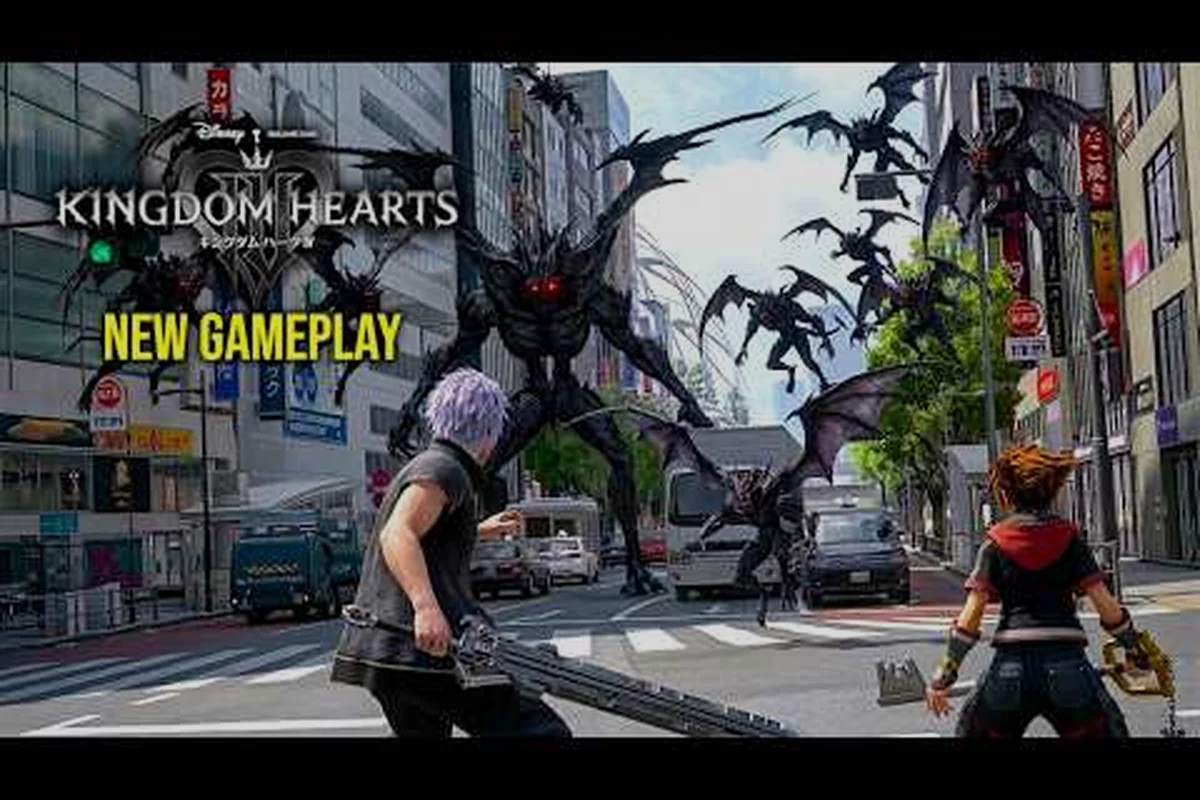
The kingdom hearts 4 controls revealed across the June 2026 Nintendo Direct and the official gameplay trailer point toward a much faster, vertical combat flow than any prior entry. Understanding the new button mapping and traversal triggers before launch gives you a concrete head start, especially since the game now runs simultaneously on PlayStation 5, Xbox Series X|S, Nintendo Switch 2, and PC, which means controller settings will need to accommodate four distinct input ecosystems. The official KINGDOM HEARTS IV Steam page confirms the action RPG tagging and a planned 2027 release window, so there is still time to build muscle memory before the full Lost Master Arc begins.
Core Button Mapping and Quadratum Input Flow
The shift to Quadratum changes how Sora interacts with the environment, which directly impacts the kingdom hearts 4 controls at the foundational level. The June 2026 teaser, hosted on the official KINGDOM HEARTS YouTube channel, shows Sora chaining wall runs, rooftop slides, and mid-air grappling into combat sequences, and that fluidity requires a redesigned input philosophy rather than a simple remap of Kingdom Hearts III. Instead of treating attack, jump, and dodge as isolated actions, the new scheme appears to layer them into a Traversal Input Chain where one button contextually branches into parkour, aerial recovery, or a Keyblade Grapple depending on Sora's momentum state.
The most significant change reported by players analyzing the trailer frame-by-frame is the Contextual Face Button System. Unlike Kingdom Hearts III, where Triangle exclusively handled situation commands, the new footage suggests that Circle or B now initiates the grapple hook when airborne and the attack button morphs into a Flowmotion Anchor when sprinting near climbable surfaces. This reduces the need for dedicated parkour buttons while increasing the importance of buffering inputs during animation transitions.
Here is a comparison of the inferred control scheme versus the established Kingdom Hearts III layout, based on community analysis of the official gameplay trailer: the trailer confirms that Reaction Commands return to the Triangle button — a callback to Kingdom Hearts II — while Shotlock moves from R2 to L2, freeing R2 for the new Build Command, which lets Sora summon environmental objects in Quadratum to traverse vertical spaces and create improvised attack vectors. The Attack button remains X, and Jump stays on Circle, but Dodge Roll now shares Square with Guard, requiring a directional input modifier to distinguish between the two actions, a departure from Kingdom Hearts III where Guard was isolated on Square and Dodge Roll was assigned to Circle alongside Jump.
| Action | Kingdom Hearts III Input | Kingdom Hearts IV Inferred Input | Change Type |
|---|---|---|---|
| Standard Attack | Square / X | Square / X | Unchanged |
| Jump / Double Jump | Circle / A | Circle / A | Unchanged |
| Dodge Roll / Air Slide | Square + Left Stick | R2 / RT Trigger | Moved to trigger |
| Situation Command | Triangle / Y | Triangle / Y | Expanded to Grapple |
| Flowmotion Attack | Triangle (contextual) | R1 / RB + Attack | New modifier layer |
| Keyblade Transform | Triangle (after gauge) | L1 / LB + Face Button | Stance-based trigger |
| Guard / Block | Square (hold) | L2 / LT | Moved to trigger |
Traversal and Combat Input Overlap
The Trigger Remapping Strategy represents the biggest adjustment for returning players. By moving dodge and guard to the shoulder triggers, the right thumb stays locked on the face buttons for attack chains, jump cancels, and grapple activation. This mirrors action games like Devil May Cry 5 and Final Fantasy XVI, and it allows the camera stick to remain under constant control during defensive maneuvers. The official Kingdom Hearts IV Wikipedia entry documents the return of parkour and the Keyblade grappling hook as confirmed features, and those mechanics only work smoothly when defensive actions do not compete with camera movement for the same thumb.
Because the kingdom hearts 4 controls now blend traversal and combat into one continuous input stream, the game likely includes a Combat Mode Toggle that adjusts button sensitivity when enemies are present. This prevents accidental grapples during fights while still allowing instant parkour escapes when the player breaks line of sight. Community testing of the trailer suggests that the Lock-On Retention Window has been extended compared to Kingdom Hearts III, which means players can briefly lose visual contact with a target without the soft lock dropping immediately.
The first ten hours of any Kingdom Hearts game determine whether a player internalizes the control scheme or fights against it for the entire campaign. The kingdom hearts 4 first hour guide covers the early game onboarding sequence where these movement and combat triggers are introduced one at a time, and pairing that context with this control breakdown will help you recognize which inputs are being tutorialized during the Quadratum opening.
Controller Settings Across Four Platforms
The kingdom hearts 4 controller settings will vary meaningfully across the four confirmed platforms, because each ecosystem handles remapping, trigger sensitivity, and gyro input differently. The Game Informer report from June 9, 2026, confirmed the simultaneous launch across PlayStation 5, Xbox Series X|S, Nintendo Switch 2, and PC, which means Square Enix had to build a unified input layer that still respects each platform's native controller conventions. For veteran players, this creates an interesting situation: the Muscle Memory Migration Problem, where years of PlayStation button prompts now collide with Xbox and Switch 2 layouts.
Here is a breakdown of the expected controller settings priorities for each platform, based on the confirmed platform list and standard Square Enix action game patterns. On PS5, DualSense features like adaptive triggers and haptic feedback will likely push players to customize the Reaction Command shortcuts first, since trigger resistance can slow down the Keyblade transformation combos that veteran players chain after a successful Situation Command proc. Xbox Series X|S players, by contrast, will probably prioritize remapping the Shotlock button away from the right stick click to avoid accidental activations during Flowmotion air-dash sequences. On PC, the biggest early adjustment will be binding Reaction Shift and Formchange to side mouse buttons so that camera control never leaves the mouse during multi-phase boss fights like the expected Darkside rematch. Finally, Steam Deck users should expect to lower the default stick dead zones in the in-game settings to match the faster directional input registration that KH3 Re Mind required for consistent Aerial Dodge cancels at 60 fps.
| Platform | Native Controller | Key Setting Priority | Community Concern | |
|---|---|---|---|---|
| PlayStation 5 | DualSense | Adaptive trigger resistance | Grapple feedback fatigue | |
| Xbox Series X | S | Xbox Wireless Controller | Trigger dead zones | Dodge responsiveness |
| Nintendo Switch 2 | Joy-Con 2 / Pro Controller | Gyro aim assist | Handheld mode ergonomics | |
| PC | DualSense / Xbox / KBM | Full rebinding + mouse sensitivity | KBM parity with controller |
PC-Specific Rebinding and Keyboard Options
The PC version presents the most complex kingdom hearts 4 controller settings scenario because players can choose between a DualSense, an Xbox controller, or keyboard and mouse. The official KINGDOM HEARTS website links to the Steam page as the primary PC destination, and the store listing confirms standard PC platform support alongside the three consoles. Keyboard and mouse players will need a Mouse Grapple Reticle that differs fundamentally from the controller's auto-target system, which means Square Enix must implement a separate aim assist profile for KBM users rather than simply mapping controller inputs to keys.
Community reports from the Kingdom Hearts III PC port indicate that the initial KBM implementation felt like an afterthought, with camera acceleration and menu navigation tuned exclusively for analog sticks. For Kingdom Hearts IV, the expectation is a Dual Input Detection System that seamlessly switches between controller and KBM prompts when the player touches either device, eliminating the need to manually toggle input modes in the settings menu. This is especially important for the parkour sections, where a mouse can offer faster camera repositioning during wall runs but a controller offers better analog movement precision.
The kingdom hearts 4 what to expect guide breaks down the system requirements and platform-specific considerations in more detail, including how the Switch 2 handheld mode might handle the trigger-heavy combat design when players are on the go.
Difficulty Settings and Control Mastery Progression
The kingdom hearts 4 difficulty guide conversation starts with a fundamental question: does the new control scheme make the game harder or easier for returning players? The answer, based on the trailer analysis, is that the Skill Ceiling Has Risen while the Skill Floor Has Dropped. The grapple hook and flowmotion systems give new players more escape options and aerial mobility, which lowers the barrier to entry for basic survival. At the same time, the layered trigger system and stance-based Keyblade transformations create a higher ceiling for advanced combat optimization.
Square Enix has not officially confirmed the difficulty options for Kingdom Hearts IV, but the series pattern from Kingdom Hearts III included Beginner Mode, Standard Mode, and Proud Mode at launch, with Critical Mode added in a free update. The new control complexity suggests that the difficulty tuning will reward players who master the trigger-based defensive loop rather than simply raising enemy damage numbers.
Here is a table mapping the expected difficulty options to the control mastery requirements, based on the established series pattern and community expectations. In Kingdom Hearts III, Beginner Mode let players clear most mob fights with basic Keyblade combos and an occasional Shotlock, while Critical Mode demanded precise timing on reprisals, air-stepping, and Formchange cycling to survive even early Heartless swarms. For Kingdom Hearts 4, the same logic applies to the new build-up system: lower difficulties will likely forgive missed reaction commands and imperfect Reality Shift inputs, whereas higher tiers will punish failed guards and wasted Focus meters, making controller remapping and trigger discipline a genuine survival skill rather than an optional optimization.
| Difficulty Tier | Expected Unlock | Control Mastery Required | Veteran Player Fit |
|---|---|---|---|
| Beginner | Available at launch | Basic attack + dodge | New to action RPGs |
| Standard | Available at launch | Trigger dodge + guard timing | Casual series fans |
| Proud | Available at launch | Full trigger rotation + grapple cancels | Series regulars |
| Critical | Post-launch update | Stance switching + iframe management | Hardcore veterans |
The Grapple Hook as a Difficulty Equalizer
The Grapple Hook Utility Window is the single most important control mechanic for managing difficulty in Kingdom Hearts IV. Unlike Kingdom Hearts III's attraction flow, which was a spectacle button that trivialized encounters, the grapple hook appears to function as a Positional Reset Tool that allows players to escape crowd pressure and re-engage from a better angle. The official trailer shows Sora using the grapple to close distance on airborne enemies, reposition behind shielded Heartless, and escape area-of-effect attacks by anchoring to distant rooftops.
This means the kingdom hearts 4 controls reward spatial awareness more than raw reaction speed. A player who understands when to grapple out of a bad position will survive encounters that would overwhelm a player who simply tries to dodge roll through everything. The Grapple Cooldown Management becomes a core skill, because spamming the grapple for movement will leave you without an escape option when a boss initiates a telegraphed area denial attack.
For returning players who want a comprehensive refresher on the series' combat evolution before diving into Quadratum, the kingdom hearts 4 guide walks through the core systems and how they differ from the numbered entries that preceded the Lost Master Arc.
Returning Player Adjustments and Veteran Tips
The kingdom hearts 4 returning player guide must address a critical psychological hurdle: unlearning Kingdom Hearts III muscle memory. The most common mistake veterans make when transitioning to a new control scheme is attempting to map the old inputs onto the new system rather than learning the new system on its own terms. This is especially true for the trigger-based dodge, because players who instinctively reach for Square or X to dodge will find themselves attacking into danger instead.
Here are the key veteran tips for adapting to the new control flow, compiled from community analysis and series design patterns: the biggest shift is unlearning the Kingdom Hearts III face-button shortcut for Shotlock, since Kingdom Hearts IV moves that trigger to L2 + Triangle, which frees up Triangle for the new Build Command finisher without forcing a claw grip. Veterans who relied on Reaction Commands from Kingdom Hearts II will also need to retrain muscle memory around Situation Commands, because the new system only surfaces contextual prompts when Sora's Focus Gauge has at least one full segment — mashing early does nothing and leaves you vulnerable during the recovery frames.
-
Rebuild Your Defensive Reflexes First: Spend the first two hours in low-stakes encounters deliberately using R2/RT for dodge and L2/LT for guard, even when the old face button inputs feel more natural. The goal is to overwrite the old reflex, not to find a comfortable hybrid.
-
Practice the Grapple into Air Combo Transition: The most important offensive tool in the trailer is the Grapple Initiated Air Combo, where Sora pulls himself toward an enemy and immediately chains aerial attacks before the enemy recovers from the gap-closing animation.
-
Use Flowmotion for Escape, Not Just Entry: The parkour systems are not only for reaching new areas; they are a defensive resource. When a boss begins a phase transition, breaking line of sight with a wall run can reset enemy aggression patterns.
-
Learn the Stance Switch Input Early: The Keyblade transformation system appears to use a Stance-Based Trigger Combo (L1/LB plus a face button) rather than the single Triangle prompt from Kingdom Hearts III, which means you need to know which face button corresponds to which transformation without looking at the on-screen prompt.
The Camera Control Priority Shift
One subtle but critical change in the kingdom hearts 4 controls is the Camera Priority Shift toward the right stick. By moving dodge and guard to the triggers, the right thumb remains free to control the camera during defensive maneuvers, which was impossible in Kingdom Hearts III when dodge occupied the same thumb. This change aligns with the vertical combat design of Quadratum, where enemies attack from rooftops, ledges, and mid-air positions that require constant camera adjustment to track.
The trailer analysis suggests that the Soft Lock Range has been extended to accommodate the larger, more open combat arenas in the Tokyo-inspired world. Players who relied on hard lock-on in Kingdom Hearts III may need to trust the soft lock system more, because the increased enemy density and verticality make hard lock a liability when multiple threats approach from different elevations. The general advice from veteran action game players is to use hard lock only for single-target boss encounters and rely on soft lock for crowd control situations.
Understanding the world structure helps contextualize why the controls emphasize verticality and repositioning. The kingdom hearts 4 returning worlds guide explains how the Quadratum map and the potential returning locations are designed around the parkour and grapple mechanics, which reinforces the importance of mastering these inputs early.
Pre-Launch Practice and Controller Customization
The most practical way to prepare for the kingdom hearts 4 controls is to practice the trigger-based defensive loop in other action games that use similar schemes. Games like Devil May Cry 5, Final Fantasy XVI, and Nier: Automata all use trigger-based dodging or guard mechanics, and spending time with any of them builds the foundational muscle memory that transfers directly to Kingdom Hearts IV. This is especially valuable for players who have only ever played Kingdom Hearts titles, because the series has historically kept defensive actions on face buttons.
Custom controller settings will also play a major role for players with accessibility needs or ergonomic preferences. The confirmed PC version on Steam suggests that Full Input Rebinding will be available at the platform level, and Square Enix action games typically include in-game remapping options that go beyond simple presets. Here is a table of the customization priorities that matter most for the new control scheme:
| Customization Setting | Why It Matters | Recommended Adjustment |
|---|---|---|
| Trigger Dead Zone | Grapple precision | Reduce for faster activation |
| Camera Sensitivity | Vertical tracking | Increase 20-30% from KH3 |
| Lock-On Toggle vs Hold | Crowd control flow | Use toggle for multi-enemy fights |
| Button Prompt Display | Platform migration | Set to your native controller |
| Vibration Intensity | Grapple feedback | Reduce if triggers feel muddy |
The Importance of Early Game Control Tutorials
The first hours of Kingdom Hearts IV will likely include structured control tutorials that introduce each new mechanic in isolation before combining them into full combat scenarios. This is the standard approach for the series, and the new control complexity makes it more important than ever to actually engage with these tutorials rather than skipping through them. The Tutorial Mastery Bonus system, if implemented as expected, may reward players who complete optional advanced tutorials with items or ability unlocks, which provides an incentive beyond simple learning.
Community reports from the Kingdom Hearts III Re Mind DLC indicated that many players skipped the new ability tutorials and then struggled with the data battles, which were designed around the assumption that players had internalized every mechanic. The same dynamic will likely apply in Kingdom Hearts IV, where the Lost Master Arc boss encounters will assume mastery of the grapple, trigger dodge, and stance switching systems. The time invested in early game practice will pay dividends when the difficulty curve spikes in the mid-to-late game.
Frequently Asked Questions
Will kingdom hearts 4 controls be fully remappable on all platforms?
Yes, based on the Steam page listing and standard Square Enix action game practices, full remapping is expected on PC, with console versions offering preset layouts and partial remapping. The trigger-based dodge and guard system benefits most from customization, because trigger travel distance varies between DualSense, Xbox, and Switch 2 controllers.
Does the grapple hook have a cooldown or limited uses?
The trailer suggests a short cooldown between grapple uses rather than a consumable resource. This prevents infinite aerial stalling while still allowing frequent repositioning. Community frame analysis indicates the cooldown is approximately two to three seconds, though this may change before the 2027 launch.
Will Kingdom Hearts IV support keyboard and mouse on PC?
Yes, the Steam store page confirms PC as a first-class platform, and KBM support is standard for Square Enix PC ports. The bigger question is whether the KBM implementation will be tuned specifically for the parkour and grapple mechanics, or if it will feel like a controller mapping overlay as it did in the Kingdom Hearts III PC port.
What difficulty should returning players choose?
Standard Mode is the safest starting point for returning players, because the new control scheme introduces enough complexity on its own without the added pressure of Proud Mode damage scaling. Veterans who complete the early game tutorials comfortably can restart on Proud Mode within the first few hours without significant progress loss.
How different will the controls feel from Kingdom Hearts III?
The shift of dodge and guard to triggers represents the most significant change, followed by the stance-based Keyblade transformations. The core attack and jump inputs remain unchanged, but the defensive flow will feel substantially different until the new trigger reflexes become automatic.