
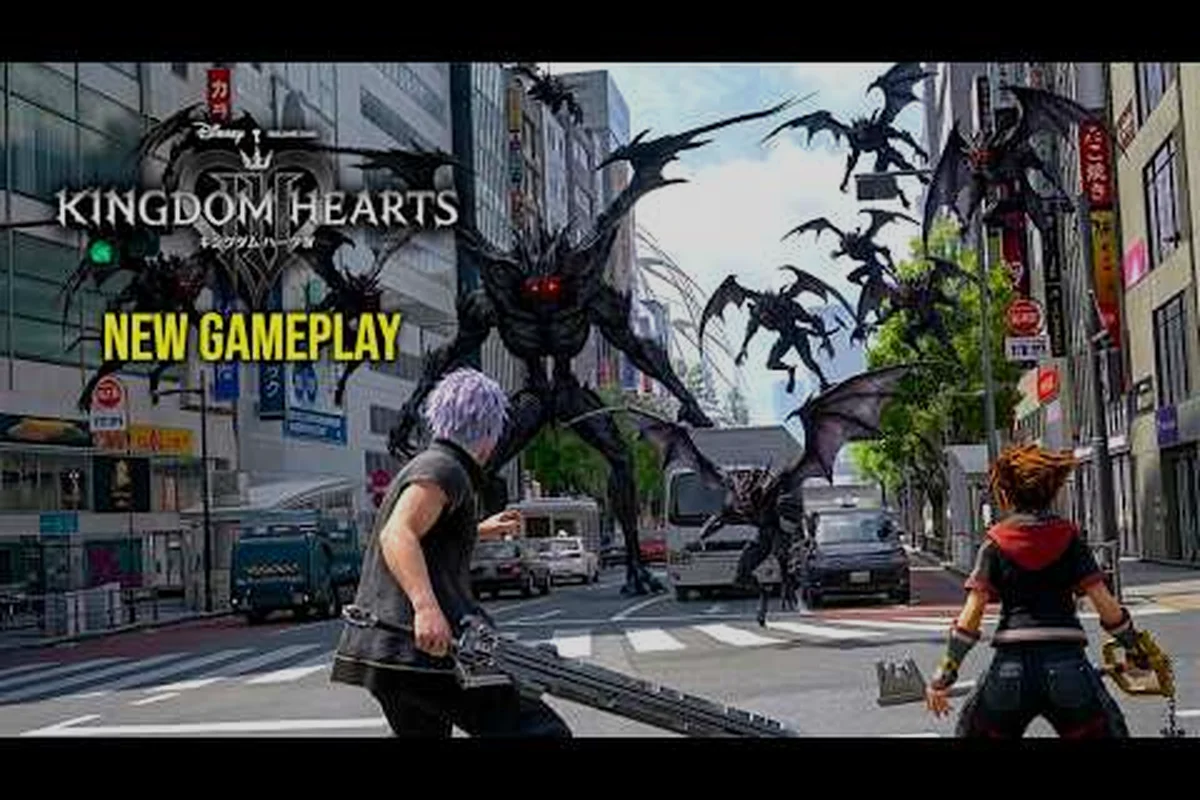
The reveal of kingdom hearts 4 minami aoyama marks a fundamental shift in how the series treats its "real world" spaces. Instead of a stylized hometown or a brief tutorial island, Sora wakes inside a photorealistic Tokyo district that functions as the Lost Master arc's primary hub. This matters because every previous KINGDOM HEARTS entry used original or Disney-inspired worlds for navigation, but Quadratum's Minami Aoyama promises grounded exploration with parkour, realistic architecture, and urban combat. Get the full breakdown of this radical kingdom hearts 4 world design pivot below.
The Quadratum Hub and Its Minami Aoyama Foundation
The first gameplay footage since the 2022 reveal, shown during a June 2026 Nintendo Direct and covered by Game Informer's report on the modern-day Tokyo gameplay, confirmed that Sora fights Heartless in Shibuya with a more realistic art direction. Minami Aoyama operates as the connective tissue for this afterworld setting, which the series now explicitly calls Quadratum. Rather than treating the city as a single corridor, the design appears to spread across multiple districts that feed into a larger real world hub.
Community analysis of the trailer footage suggests three distinct traversal layers within kingdom hearts 4 minami aoyama. The ground-level retail streets, modeled after the actual Shibuya–Minami Aoyama corridor, handle dense pedestrian flow and storefront detail, while the elevated walkways and building interiors introduce a verticality that echoes the Flowmotion scaling of previous titles but with a more grounded, real-world restraint. These layers are not confirmed as separate maps, but they reflect how the camera and movement systems frame the space — and how Quadratum’s afterworld logic could later peel each layer into discrete combat or exploration zones.
| Traversal Layer | Likely Function | Visual Cues From Footage |
|---|---|---|
| Street level | Primary navigation, NPC encounters, shop access | Crosswalks, storefronts, dense signage, pedestrian paths |
| Rooftop level | Parkour routes, Heartless ambushes, vertical shortcuts | Sora leaping across ledges, air-stepping between buildings |
| Interior pockets | Story scenes, apartment entry, hidden collectibles | Doorways, stairwells, glass facades reflecting interiors |
The street level grounds the experience because it forces players to engage with realistic scale, while the rooftop layer rewards observation. A player who only follows the main road will miss upper-level chests, but a player who constantly climbs will lose the environmental storytelling embedded in storefronts and side alleys.
A Tokyo Hub That Breaks the Loop Layout
Traverse Town, Twilight Town, and Radiant Garden all used compact, looped layouts with clearly marked exits. Kingdom hearts 4 minami aoyama appears to break that pattern by introducing asymmetric city blocks and multi-entry buildings. The result is a hub that feels less like a game level and more like a navigable district, which aligns with the kingdom hearts 4 real world marketing angle.
The difference is not purely cosmetic. In older hubs, every door either opened or was permanently locked, and the map guided you toward the next story trigger. In the Quadratum footage, Sora can climb over barriers that would have been invisible walls in previous games. This is the parkour system from the official trailer doing structural work, not just adding flair.
Tokyo Shibuya Gameplay Systems Inside the Afterworld
The kingdom hearts 4 tokyo shibuya gameplay loop combines fast combat, vertical movement, and the Keyblade grappling hook. The official KINGDOM HEARTS channel teaser from June 2026 shows Sora waking up in the city, running across rooftops, and switching Keyblades mid-battle. These mechanics are not isolated to combat arenas; they are integrated into how Minami Aoyama itself is traversed.
Movement appears to follow a three-step rhythm. First, the player reads the environment for grapple points or parkour ledges. Second, Sora commits to a route that may trigger a Heartless ambush. Third, combat resolves quickly, after which the route continues. This loop keeps traversal and fighting connected rather than separating them into exploration phases and battle phases.
| Gameplay Element | Minami Aoyama Application | Player Skill Tested |
|---|---|---|
| Parkour | Crossing intersections, scaling shops, reaching rooftops | Route planning, camera control |
| Keyblade grappling hook | Pulling to upper floors, escaping ground swarms | Reaction speed, vertical awareness |
| Mid-battle Keyblade switching | Adapting to enemy types on narrow streets | Loadout knowledge, timing |
| Environmental interaction | Using ledges and signs as launch points | Spatial judgment |
The Keyblade grappling hook deserves special attention because it changes how players approach urban verticality. In previous titles, reaching a high ledge required either a specific flowmotion prompt or a scripted event. Here, the hook appears to work on multiple surfaces, which means Minami Aoyama can hide rewards at different elevations without forcing a single correct path.
The Afterworld Framing and Real-World Tension
The term afterworld is not just a lore label; it shapes the tone of the entire district. Sora is trapped in a world that looks like modern Tokyo but operates under rules he does not fully understand. This creates a constant tension between the familiar and the uncanny, which the level design reinforces through quiet residential streets that suddenly flood with Heartless.
Players have noted that the color grading in kingdom hearts 4 minami aoyama footage is colder than the warm palettes of Disney worlds. That contrast is intentional. It signals that this is a world between worlds, not a vacation destination, and it affects how players read safe zones versus danger zones.
World Design Lessons From the Minami Aoyama Reveal
Kingdom hearts 4 world design has always balanced spectacle with navigability, but the Minami Aoyama footage suggests a stronger emphasis on environmental legibility. The district uses real-world landmarks, signage, and road markings to orient the player without relying on a mini-map overlay. This is a meaningful change because previous hubs often depended on glowing objective markers.
Several design principles can be extracted from the reveal footage, beginning with the Quadrupedal Golem Heartless chase sequence through the Minami Aoyama crossing — the camera stays low and tight to Sora's sprint path, using storefront signage and the 104 Building silhouette as constant spatial anchors rather than objective markers. This creates what the trailer calls a "sightline corridor," where every shop awning and pedestrian crossing funnels the player toward the Afterworld breach point at the Shibuya Stream intersection. The second principle involves vertical compression: unlike the floating-platform sprawl of past worlds, the real world Tokyo Shibuya environment layers threat on elevated walkways and subway entrances simultaneously, forcing the player to track the Darkside Heartless attack telegraphs across three stacked sight planes.
-
Street width matters: Wider roads create natural combat arenas, while narrow alleys funnel Heartless into predictable attack lanes.
-
Storefront density communicates progress: The number and type of open shops may shift as Sora's presence in Quadratum changes.
-
Verticality is optional but rewarded: Rooftop routes offer faster travel, but street-level exploration contains more narrative details.
-
Lighting marks threat: Cool, dim areas appear to signal danger before enemies actually spawn.
These principles align with the broader kingdom hearts 4 new worlds strategy. The development team seems to be treating Quadratum not as one large map but as a collection of districts, each with its own identity. Minami Aoyama is the polished residential and commercial core, while other areas may push the uncanny aesthetic further.
Quadratum as a World System, Not a Single Stage
Calling Quadratum a "world" undersells what the footage implies. The hub appears to support multiple entry and exit points that connect to other realms, including the Coco-inspired world revealed at D23 2026. This means Minami Aoyama may function as a persistent base that players return to between Disney excursions, similar to how Traverse Town operated in the first game but with far more environmental complexity.
The internal link between Quadratum's districts and the full list of confirmed and speculated KINGDOM HEARTS IV worlds is worth tracking because Minami Aoyama is only the starting point. If the hub expands outward, players may eventually access other Tokyo districts or entirely different Quadratum regions.
Exploration Rewards and Hidden Spaces in Minami Aoyama
A realistic city hub only works if exploration feels worthwhile, and the kingdom hearts 4 minami aoyama footage hints at several reward categories. Players who wander off the main path are likely to find synthesis materials, lore fragments tied to the Lost Master arc, and optional combat encounters that drop rare items.
The apartment where Sora wakes appears to be a recurring safe zone. Community reports describe it as a modest room with a bed, a desk, and a window overlooking the district. If it follows series tradition, the apartment will gradually accumulate trophies, photos, and items that reflect story progress, making it a personalized hub within the hub.
| Reward Type | Likely Location | Discovery Method |
|---|---|---|
| Synthesis materials | Dumpsters, vending machine areas, hidden rooftop corners | Parkour off the main route |
| Lore fragments | Storefront signs, posters, NPC dialogue triggers | Slow street-level exploration |
| Rare Heartless spawns | Alleys, parking structures, underpasses | Returning at specific story beats |
| Cosmetic or key items | Locked interiors, upper-floor rooms | Grappling hook puzzles |
The reward loop encourages players to revisit Minami Aoyama after major story events. A district that looks the same but contains new triggers is a classic KINGDOM HEARTS technique, and the realistic setting makes those changes feel more subtle and therefore more rewarding to notice.
Comparing Quadratum Navigation to Classic Hubs
The navigation shift is easier to appreciate through a direct comparison with older hub worlds. In previous entries, hubs like Traverse Town or Twilight Town used clearly marked exits and compact, looping layouts that funneled Sora toward story triggers. Quadratum, by contrast, draws from kingdom hearts 4 minami aoyama and the broader Tokyo Shibuya gameplay space, where real-world scale, traffic barriers, and vertical storefronts obscure the critical path. This is why the table below outlines the core differences players should expect when they first step into kingdom hearts 4 minami aoyama — the friction comes not from combat difficulty, but from learning to read an environment modeled on the real world rather than a theme-park abstraction of one.
| Feature | Classic Hubs | Minami Aoyama |
|---|---|---|
| Map layout | Compact loops, clear exits | Asymmetric blocks, multi-entry buildings |
| Vertical access | Scripted prompts, limited climbing | Free parkour, grappling hook |
| Visual language | Stylized, game-like | Photorealistic, real-world signage |
| Enemy placement | Fixed spawns in open areas | Ambush-based, tied to traversal routes |
| Safe zones | Marked save points | Apartment and possibly other interiors |
This table should not be read as "new is better" but as "new is different." Players who loved the cozy readability of Twilight Town may need time to adjust to a hub that feels more open and less explicitly guided. The returning worlds guide covers how older locations may reappear, and the contrast between those spaces and Quadratum will define the game's pacing.
The Narrative Weight of Waking Up in Minami Aoyama
Sora's arrival in kingdom hearts 4 minami aoyama is not a peaceful reset. According to the Wikipedia entry for KINGDOM HEARTS IV, the game begins the Lost Master arc after KINGDOM HEARTS III and Melody of Memory, with Sora trapped in the life-like world of Quadratum. The district's realism is therefore a narrative device as much as a gameplay choice. A world that looks like our own makes Sora's displacement feel more acute.
The presence of Strelitzia and the figure fans have identified as Sigurd in the extended D23 trailer adds another layer. These characters are tied to Union Cross lore, and their appearance in a realistic Tokyo setting suggests that Quadratum is not just a prison but a meeting point for people who have been erased or displaced from other worlds. Minami Aoyama becomes the stage where those threads converge.
Why the Real World Matters for the Lost Master Arc
The kingdom hearts 4 real world concept is not simply an aesthetic experiment. It gives the writers a new tool: the ability to contrast Sora's fairy-tale logic with a world that operates on mundane rules. When Heartless invade a crosswalk, the horror is sharper because the setting is familiar. When Sora leaps between buildings, the fantasy is more exhilarating because the architecture is plausible.
This tension may explain why the developers chose Minami Aoyama specifically. The district is known for its mix of high-end retail, residential quiet, and cultural landmarks, which provides a varied backdrop for both story scenes and combat encounters. A purely commercial district would lack intimacy, while a purely residential one would lack scale.
What New Players Should Watch for in the Opening Hours
For players planning to jump into KINGDOM HEARTS IV when it launches in late 2027, the kingdom hearts 4 minami aoyama opening will set the tone for the entire experience. Several details are worth tracking early because they may affect how comfortably you settle into the new systems.
The first hour will likely teach the parkour system, the Keyblade grappling hook, and the mid-battle Keyblade switching in sequence. Each mechanic gets a safe introduction before being combined. Pay attention to how the camera frames rooftops and ledges, because the visual language of climbable surfaces is different from the glowing prompts of older games.
The KINGDOM HEARTS IV beginner guide offers a broader overview of early-game priorities, but for Minami Aoyama specifically, focus on three habits. First, clear every Drift enemy pack along Omotesando before the first save point — each pack drops between 15 and 40 Munny, enough to buy one extra Hi-Potion from the shop in the backstreets before the encounter triggers. Second, check the station-side alcoves for Reality Shift prompts after each story beat; these despawn permanently once you enter the Afterworld, and missing one locks you out of the early Cheer ability. Third, avoid engaging the Vexen-masked Reaper patrol that circles the crossing near the Scramble until you have at least 700 HP and the Aero magic unlock, because its phase-two sweep hits for 340 damage per lunge and cannot be dodged inside the crowd-dense real-world geometry.
-
Scan intersections before crossing because ambush triggers appear to cluster around open spaces.
-
Climb early and often to build spatial awareness of the district before story events change the map.
-
Revisit the apartment after each major cutscene to check for new items or dialogue options.
These habits turn the hub into a resource rather than a hallway. A player who treats Minami Aoyama as a place to pass through will miss the environmental storytelling that makes the afterworld feel alive. Watch for the contrast between the real world Shibuya's crowded scramble and the afterworld Minami Aoyama's quieter, emptier storefronts — boarded-up windows and faded signage imply a recent catastrophe rather than a simple parallel dimension. Stopping to read these details clarifies how Quadatum's rules differ from the Tokyo Shibuya gameplay players first see in the reveal trailer.
Anticipating the Full Quadratum Map
Minami Aoyama is almost certainly only one slice of Quadratum. The official trailers have shown other urban angles, and the presence of the Coco world confirms that Sora will leave the city eventually. The question is whether Quadratum expands into additional Tokyo districts or whether other real-world cities appear as separate zones.
Community speculation points toward a multi-district Quadratum with Minami Aoyama as the anchor. If true, the hub may eventually include areas inspired by other Tokyo neighborhoods, each with its own gameplay identity. This would make kingdom hearts 4 world design the most ambitious in the series, because each district would need to feel distinct while remaining part of a coherent whole.
Frequently Asked Questions
Is Minami Aoyama the only real-world location in KINGDOM HEARTS IV?
Minami Aoyama is the primary real-world district shown so far, but it is part of the larger Quadratum afterworld. The official trailers have focused on Shibuya and Minami Aoyama, while other footage hints at additional urban spaces. More districts may appear as the Lost Master arc progresses toward the late 2027 release.
How does the Keyblade grappling hook work in Minami Aoyama?
The grappling hook lets Sora pull himself to ledges, upper floors, and escape routes during both traversal and combat. It appears to work on multiple surface types rather than fixed anchor points, which gives players freedom to create vertical shortcuts. The mechanic was shown clearly in the June 2026 official gameplay teaser.
Can I explore Minami Aoyama freely, or is it story-gated?
The opening sections are likely structured to teach movement and combat, but the district should open up as you progress. The hub design suggests optional exploration with hidden rewards, so returning to earlier areas after story beats will matter. Some interiors and upper floors may remain locked until specific triggers occur.
What makes the kingdom hearts 4 real world setting different from Twilight Town?
Twilight Town was a stylized, cozy hub with clear boundaries and game-like logic. Minami Aoyama uses photorealistic architecture, real-world signage, and a colder color palette to create tension between the familiar and the uncanny. The verticality is also far more open, with parkour and grappling replacing scripted climb prompts.
Will Minami Aoyama change as the story progresses?
The kingdom hearts 4 minami aoyama reveal is more than a visual upgrade; it is a statement about how the series can evolve without losing its identity. Which part of the realistic Tokyo district are you most excited to explore first when the game launches in late 2027?